
Traditionally, learners are introduced to psychological skills by learning the basics of goal setting, visualization, and self-talk (Weinberg & Gould, 2019). My preferred approach starts with the understanding of basic psychological principles, helping learners recognize their innate tendency for self-regulation, imagining future outcomes, and setting goals. By reflecting on past experiences where these tendencies helped them overcome challenges, learners gain insight into their existing strengths.
Consequently, the purpose of psychological skills training is to help them intentionally leverage these strengths to enhance performance and resilience. This approach requires a paradigm shift from viewing the learners as passive recipients of knowledge, waiting to be taught specific skills, to the assumption they already possess the innate resources needed to succeed (Rogers, 1995).
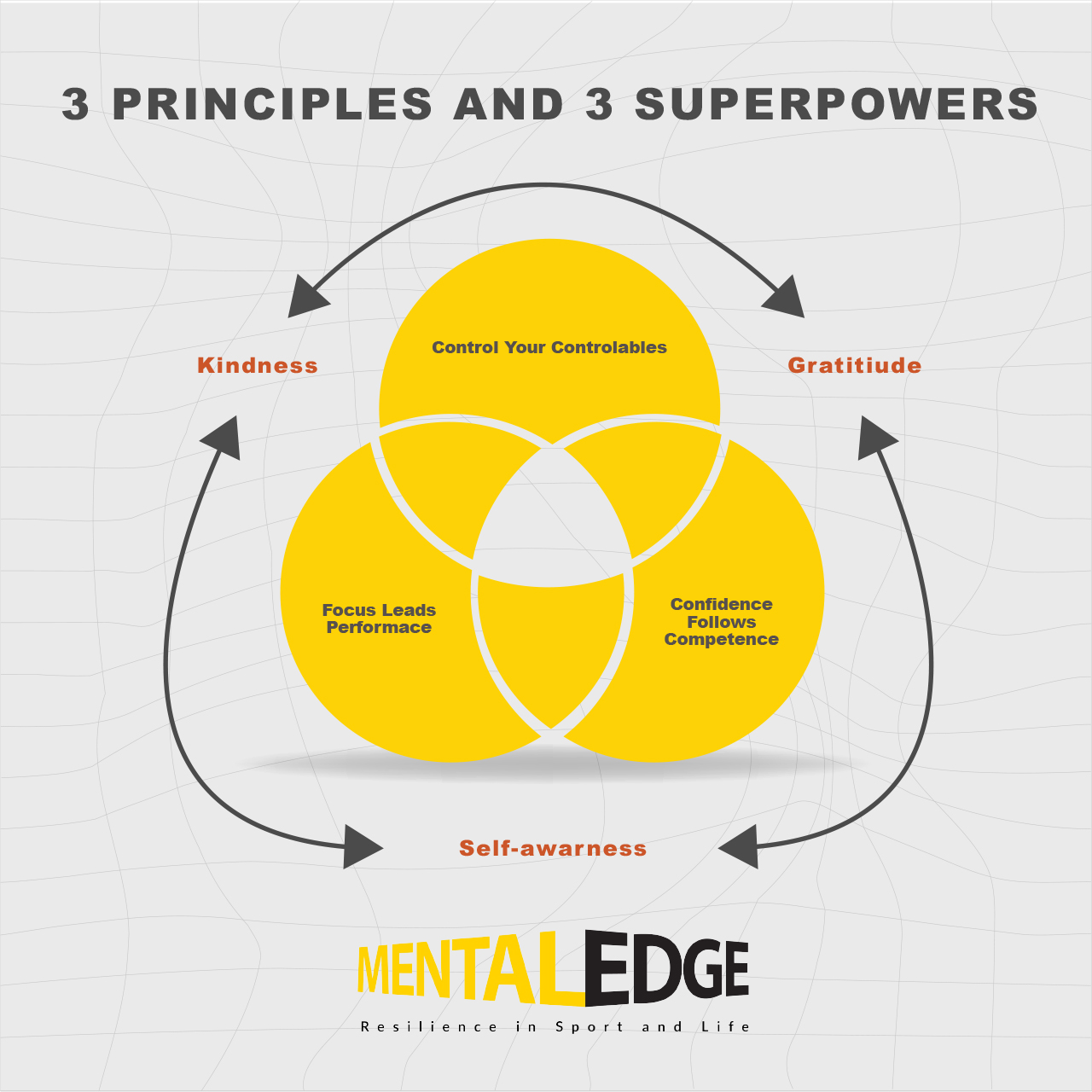
Drawing from my training and experiences, I have developed a psychological skills training model based on a principles-first approach. This model is built around three basic principles—Control Your Controllables, Confidence Follows Competence and Focus Leads Performance. It aligns performers with their innate psychological strengths, improving attributes like confidence and focus. These are further enhanced by fostering the “superpowers” of Self-awareness, Gratitude, and Kindness.
The Three Related Principles
Control Your Controllables encourages performers to direct their energy toward factors within their control – their actions, responses, and perspective, rather than being worried or distressed over things that are not within their direct control – past mistakes, external outcomes or other people’s judgements. By focusing on what they can control and what matters, they will be able to perform with greater focus and confidence (Burton, 1989; Carver & Scheier, 1982).
Confidence Follows Competence underlines how, as performers consistently demonstrate competence by mastering skills and handling the demands of their sport, their confidence grows. And the more confident they feel, the more inclined they are to trust their abilities. Consequently, confidence is not just about positive thinking but grounded trust in one’s competence, built through training and experience (Bandura, 1977).
Focus Leads Performance; by understanding that focus is never lost but often misdirected (Eysenck & Derakshan, 2011), performers can learn to actively use positive emotions and mental skills to steer their attention away from distractions such as expectations and self-doubt, and back toward task-relevant cues. This skill of refocusing anchors performers in the present, allowing them to trust and adapt instinctively to the demands of the game.
This approach requires a paradigm shift from viewing the learners as passive recipients of knowledge, waiting to be taught specific skills, to the assumption they already possess the innate resources needed to succeed
Each of these principles reinforces the other to foster performance attributes. For example, the principle of Confidence Follows Competence builds on Control Your Controllables. When performers focus on their actions, responses, and preparation—things within their control—they seize opportunities to practice and refine their skills. This consistent and deliberate effort to develop competence becomes a stable source of confidence, particularly under high-pressure situations. Focus Leads Performance guides attention toward relevant, controllable cues, helping performers manage distractions and maintain a steady, present-centred focus essential for optimal performance.
In the next blog post, I will delve into how psychological skills emerge from understanding these three interconnected principles. For the third and final post, I will also explore in greater depth the “superpowers” of Self-awareness, Gratitude, and Kindness, and how they further enhance performance and resilience. By integrating these concepts, learners can build a solid foundation for psychological growth, empowering them to navigate challenges with confidence and clarity.
Coach Hansen
References:
Bandura, A. (1977). Self-efficacy: Toward a unifying theory of behavioral change. Psychological Review, 84(2), 191–215. https://doi.org/10.1037//0033
Burton, D. (1989). The impact of goal specificity and task complexity on Basketball Skill Development. The Sport Psychologist, 3(1), 34–47. https://doi.org/10.1123/tsp.3.1.34
Carver, C. S., & Scheier, M. F. (1982). Control theory: A useful conceptual framework for personality—social, clinical, and health psychology. Psychological Bulletin, 92(1), 111
Eysenck, M. W., & Derakshan, N. (2011). New Perspectives in attentional control theory. Personality and Individual Differences, 50(7), 955–960. https://doi.org/10.1016/j.paid.2010.08.019
Rogers, C. R. (1995). A way of being. Houghton Mifflin.
Weinberg, R.S., & Gould, D. (2019). Foundations of sport and exercise psychology (7th ed.). Champaign, IL: Human Kinetics.
 Coach Hansen
2 thoughts on “Principles First Approach to Mental Resilience (Part 1 of 3)”