Feedback should be Immediate and Specific…Really?

We may not exactly know why but many coaches have figured out intuitively that immediate feedback may not always be effective, even for beginners. I was recently reminded about this when I came across news that Dr. Peter Vint left Everton as the academy’s director. Many years back, a PE teacher showed me Peter Vint’s study explaining how frequent feedback may not necessarily be better for skill development. Only then did I realize that there were many studies since the 90s with similar findings.

“There are exactly two things which contribute more to the development of skill and human performance than anything else. These two things are practice and feedback. Without one, the other is ineffective and in some cases can be completely useless.” Dr. Peter Vint

This may sound familiar to other coaches too – I am correcting my player’s backswing but as soon as his backswing was high enough, other parts of the skill (such as the follow through and bent knee) breaks down. Mistakes that he didn’t commit initially will surface as he brings his attention to that one thing or cue that you tried to enforce. And when I leave the player to practice alone (usually when I get frustrated), he suddenly gets it, seemingly miraculously.

Promote Introspection and Avoid Dependency

A possible explanation would be that immediate feedback causes the athlete to constantly react to different cues without fully understanding the “whole” skill. For example, my player could be doing multiple throws and after each throw I will be barking “higher back swing”, “lower release”, “faster approach” etc. etc…This may also cause anxiety which has implications on the ability to learn too.

Meanwhile, in the absence of extrinsic feedback, the learner is forced to rely on intrinsic feedback instead, i.e., he begins to recognize his errors and feel what the correct execution is like through a process of testing, feeling and introspection. He begins to feel and understand why he has to execute the skill in a certain way instead of just being told how to. Other instructional approaches such as Games for Understanding, process based feedback and peer learning (through vicarious observation and discussion) also promotes introspection, independent decision making and ultimately self-directed learners (instead of having to rely on external feedback all the time).

Ultimately, we want our athletes to be able to learn on their own without being overly reliant on us.

Coach Zai
Photo courtesy of Coach Zai

Here are some pointer for giving feedback that I’ve jotted down from these studies…

  1. Wait a few seconds or tolerate some mistakes first before giving feedback .
  2. Ask learner to self-evaluate before providing feedback
  3. Positive – Instead of “Stop gripping so tightly”, say “Relax your grip” (Golf)
  4. Make use of bandwidth feedback – for beginners feedback should be frequent and general, i.e., “ball park info” such as “reach and glide further (swimming)”, since they are still unable to make use of detailed information.
    As skills improve, reduce the frequency and use specific cues instead (refer to Gentile’s Model to understand this better).
  5. It’s NOT necessary to give feedback when the outcome of the skill is easily detectable, e.g., whether the shot is on target or otherwise.
  6. ASK the learner when best she would like to have feedback.
  7. Make use of processed based feedback, or even stories and summaries that encourage introspection during the review of the lesson.

We’ve got to be flexible and take the stage of learning (The 4 Stages of Competence) into consideration when applying these pointers.

p.s. Let’s remember that we are coaches and NOT Kiasu mothers who are persistently reminding their kids what to do and what not to do!

Coach Hansen
 

Before you criticize a Coach…

It happened again! Almost every time I am watching the game from the stands, I’ll hear parents questioning the coach while talking among themselves. I’ve been on the receiving end too – from spouses, officials and even volunteers. In some rare cases, they not only question my methods and/or tactics, but also advise the players to go against them.

Before people criticize coaches (or anyone), they should first ponder over these questions (or perhaps they should themselves go try coaching for a season first)…

  1. Am I criticizing so that I can have an excuse to say “I’m better than you”?
  2. Am I blaming the coach so that I’ll have an excuse to defend my kid or spouse when comparing them with the better athletes?
  3. Is the coach really doing something incorrectly OR, I just have a preference for how a coach should be like? (Some parents may unknowingly prefer coaches who are like themselves, i.e., biased towards their own kids just like themselves).
  4. Do I have the whole picture? A coach may seem to be overly harsh on a player, or be deemed unfair in his handling of the team. Perhaps she has good reasons for doing so and I should clarify with her instead?

Of course, some criticism are well-meaning and since we can’t afford to stop learning and listening, we should be open to suggestions on how we can get better. On our part, we can also be more proactive by having meetings with partners to establish certain communication guidelines, and to also share our training plan with them whenever possible.

“Learn to take criticism seriously but not personally.” Hillary Clinton

Anyways, as coaches, I reckon criticism is to be expected…that’s the nature of our job isn’t it? In fact some of the most critical people are coaches themselves – often of other coaches! Sometimes we just have to close our ears and let these fellas say what they want to say lah…it’s their problem, not mine.

Coach Hansen

Putting It into Context…

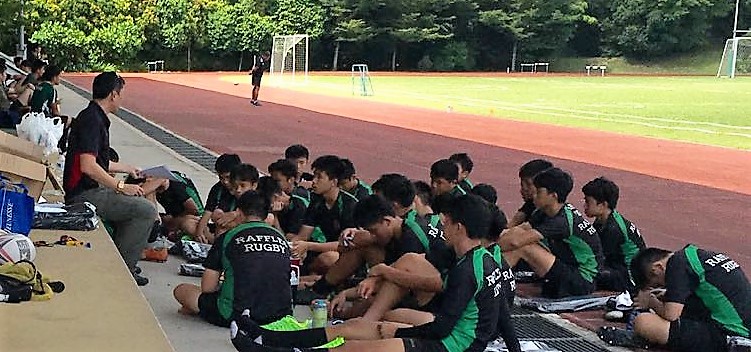
The boys are much more serious about learning and applying mental skills after a couple of competitive games – they are paying attention and asking questions to clarify instead of just “pretending” to be learning.

Mental Prep for Monday's Game vs ACSB
Mental Prep for Monday’s Game vs ACSb

As a psychology coach, I have gotten quite used to this especially with the younger C-Division athletes. These fellas struggle to understand the relevance of mental skills since they can’t really associated the material with a concrete and authentic context, i.e., they often have little or no prior experience of having to perform under pressure.

Contextual Teaching and Learning (CTL) is a concept that reflects a common sense notion that learners learn better when they are taught knowledge within the context of actual experience, rather than abstractly. As much as I try to incorporate CLT strategies into my coaching such as getting the players to focus on process goals under simulated conditions, it seems that nothing beats “real life” experience!

I reckon this is true even outside the context of sport. My former student was sharing investment advice with me last week, and I probably wouldn’t be able to make sense of the advice if I did not have the relevant experience in biz and investments.

“Learning only occurs when the learner wants to learn, is ready to learn, and has a reason to learn…”

Furthermore, I am sure all of us have experienced some sort of screw ups at work or even in relationships, and it was only on hindsight that we realize that all the trouble could have been avoided if we had heeded or remembered a particular someone’s well-meaning advice, which at that point in time seemed irrelevant and/or unnecessary!

I guess it’s human to err, and to err is probably the best way for humans to learn!

Coach Hansen