Part 3: Unlocking the Superpowers…

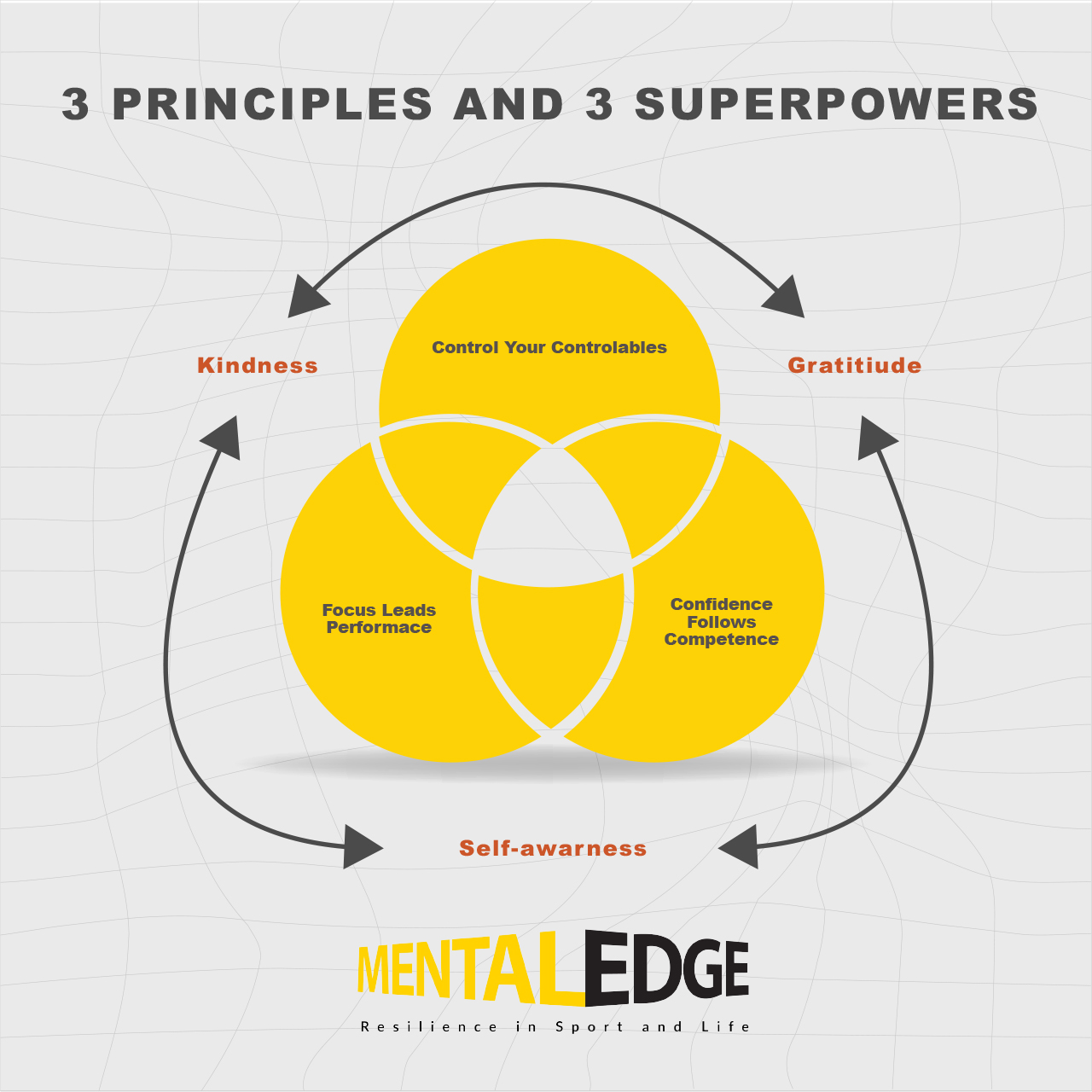
As performers become more acquainted with the three principles—Control Your Controllables, Confidence Follows Competence, and Focus Leads Your Performance—the superpowers of Self-awareness, Gratitude, and Kindness naturally emerge.

For example, as performers consistently apply Control Your Controllables, they become more aware of their emotional triggers and habitual reactions during competition. A practitioner can then underline how Self-awareness enhances this principle by helping performers recognise when they are fixating on uncontrollable factors, such as an opponent’s performance or a referee’s call. By noticing these patterns, they can consciously redirect their focus toward what they can control—such as their breathing, focus routines, or tactical adjustments—allowing for more composed and effective performance. Self-awareness also helps them tap into their innate confidence by recognizing areas of growing competence (Confidence Follows Competence) and redirecting attention toward task-relevant cues (Focus Leads Performance) during high-pressure moments.

By now, you’ve seen how Self-awareness enhances the three principles by helping performers recognize and manage their internal responses. As I expand on Gratitude and Kindness, I encourage you to think about how these superpowers might also amplify the principles, and how they could transform a performer’s approach to challenges and growth.

Continue reading “Part 3: Unlocking the Superpowers…”
Principles First Approach to Mental Resilience (Part 1 of 3)

Traditionally, learners are introduced to psychological skills by learning the basics of goal setting, visualization, and self-talk (Weinberg & Gould, 2019). My preferred approach starts with the understanding of basic psychological principles, helping learners recognize their innate tendency for self-regulation, imagining future outcomes, and setting goals. By reflecting on past experiences where these tendencies helped them overcome challenges, learners gain insight into their existing strengths.

Consequently, the purpose of psychological skills training is to help them intentionally leverage these strengths to enhance performance and resilience. This approach requires a paradigm shift from viewing the learners as passive recipients of knowledge, waiting to be taught specific skills, to the assumption they already possess the innate resources needed to succeed (Rogers, 1995).

Continue reading “Principles First Approach to Mental Resilience (Part 1 of 3)”

Asking the correct questions…

Imagine that you are trying to complete an assignment, learn a skill or to achieve a certain milestone.

The undertaking seems more difficult and requires more effort than you initially assumed.

As a result, you are somewhat frustrated and might be asking yourself one of these questions…

AB
“Why can’t I get this right?”
“Why do I have to do this?”
“What have I done wrong?”
“What can I do differently?”
“How can I break this down into simpler steps?”
“What can I learn from this?”

What’s the difference between these two groups of questions?

Would you feel and respond differently to questions from group A compared to group B?

What if you are a coach, what sort of questions would you ask your athlete?

Will they resemble questions from Group A – “Why can’t you get this right?” or Group B – “What can you do differently?”

Like most people, you would likely be more cognitive and solution-focused when you ask yourself questions from Group B.

Meanwhile, questions from Group A are likely to compound your frustration. You may even respond defensively when these questions are directed at you.

So what’s responsible for this difference in the way we feel and respond to these questions?

An understanding about how different regions of our brains respond to these questions will give us a better idea!

Continue reading “Asking the correct questions…”