Let’s Reflect: Why Bother?

Despite increasing acceptance of reflective practices as part of coach education, there seems to be little understanding on what reflection is, why it’s necessary, and ultimately why we are NOT doing it!

10 years of coaching experience may simply mean doing the same thing 10 times over.

What’s Reflection?

It’s often understood (NOT incorrectly) as the process of hindsight and learning what needs to be done in order to improve practice in the future. According to one definition, it involves “paying critical attention to the practical values and theories which inform everyday actions, by examining practice reflectively and reflexively.”

Why the Need for Reflection?

Indeed, coaches learn best through coaching itself (see previous article) but on the same note, 10 years of coaching experience may simply mean doing the same thing 10 times over. Learning is not an automatic by product of experience!

Research in different fields have shown that performance improves significantly when learners deliberate on and codify their experience. Coaching is no exception and here’s a research project specific to Sport Coaching. It IS possible to train and learn smarter instead of simply harder!
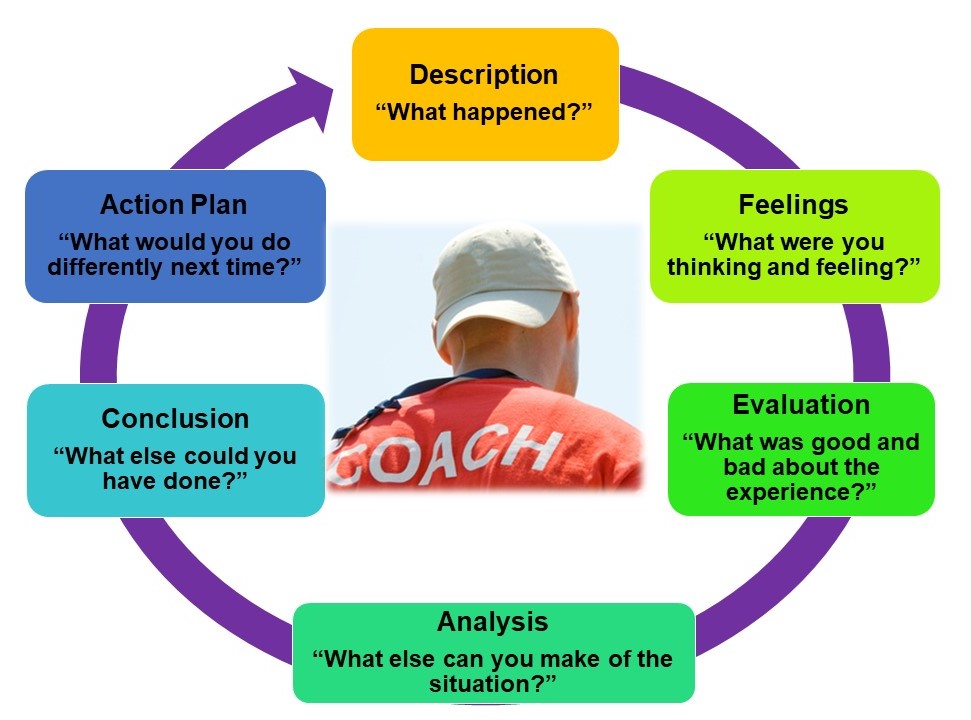
Reflection Cycle

Why we are NOT practicing reflection

I learnt about reflection during my formal education years in PE and later in Psychology. Also came across the mention of it countless times. You would assume that I must be quite an avid “reflector” having been exposed to it so often. Wrong! Despite being reminded of its importance for almost two decades, I’ve never treated it seriously until about five to six years back.

Here’s why it took me ages to get started! Pretty sure some of you will be able to relate…

  1. Too Complex
    The Gibb’s Reflective Cycle was my introduction to reflection during my undergraduate years. I was probably too immature at that time to understand the whole process which seemed weird and unnecessary.
  2. No Time or A Waste of Time
    There’s always too much work to do and deadlines to meet hence it feels all too counter intuitive to spend time doing something that does not have any “immediate” impact.
  3. “Airy Fairy”
    Most structured reflection involves some sort of “getting in touch with your feelings” shite was took me a while to get used to. Besides, I’m biased against persons who seem to be only thinking all the time (for good reason!). Always felt that these fellas are simply procrastinators.

So what made me finally decide to practice reflection regularly?

Well, like all coaches, I’ve always looking for ways to improve my athletes’ performance. Despite not practicing reflection myself, I decided to be a “hypocrite” and made reflection a part of every training session for the primary school rope-skipping team that I used to coach. I even designed simple thinking routines to help them make better sense of their training and experiences. For the athletes that I was working with as a psychology coach, I made a more deliberate effort to improve the quality of our facilitated conversations.

In short, it was my athletes’ success that inspired me to get started on regular reflection – my primary school athletes won three out of four division titles that year (despite having less training sessions due to budget cuts), and my psychology athletes were able to understand and apply the mental skills more effectively!

“Learning is not an automatic by-product of experience!”

As a coach, I began to get generative ideas for organizing practice and effective feedback. I also became more aware of how my own emotions affect my athlete’s learning. Instead of being a waste of time, regular reflection actually “saves time” – I was clear about what worked and what didn’t, and manage to get more done with less time.

Is “No time” also your excuse?

If you would like to start practicing reflection, here’s a link to reflective models that you could use. It’s advisable to follow a model for a start since hindsight tends to be biased and superficial. Ironically, the model that I use for reflection today is the Gibb’s Reflective Cycle! The same model that turned me off from reflecting when I was 21 years young!

Coach Hansen
Bpàt-jù-ban

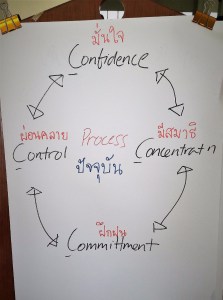
The Thai word bpàt-jù-ban means ‘Present’ or ‘Now’. I learnt this from the participants during the recent ‘IPC Intro to Para Coaching Course’ in Korat, Thailand.

IPC Korat
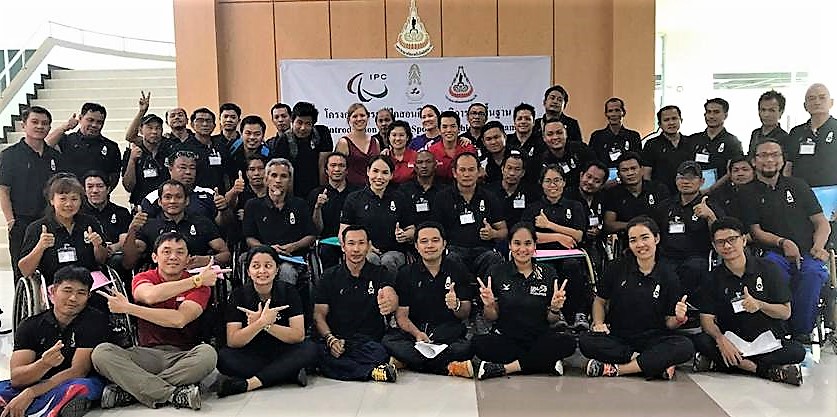
International Paralympic Committee (IPC) Intro to Para-Coaching Course at Korat, Thailand

While I was sharing with the Thai coaches why it was important for an athlete to refocus on the process goals whenever she “time traveled” to outcome goals or past mistakes. One of the coaches shared (through a translator) that this was similar to bpàt-jù-ban – a Buddhist notion familiar to the Thais about not dwelling on the past nor dream of the future, but to be in the present/ bpàt-jù-ban.

Bajuoan small
The word under Process is bpàt-jù-ban


I got excited when I learnt of this as my main purpose for coaching mental skills has always been to help athletes see the relevance of these skills not only in sport, but in life.

So What Does it mean to be Present or Process Focused?

I would explain it as simply keeping things simple, and the best way to keep things simple is to be in the present – to be in the here and now by focusing on the process instead of the outcome. Sounds simple? Well, it’s simple but definitely not easy. In fact, it is even counter-intuitive!

When you relate this to training and goals…It simply means to shift away from your outcome goal (e.g., to move and react faster during games) to focusing on the training process (e.g., adding 10 minutes of quick feet and reaction drills before every practice session). Athletes who have the ability to let go of their “time” or outcome goals are usually the ones who achieve them.

If you think about it, success really depends on how effective we are in accomplishing a series of practice goals isn’t it? This requires consistent energy and focus and being constantly distracted by worries about not being able to achieve your end goal isn’t going to help.

What it means for skill development and competition…is to focus on the performance and mental cues (e.g., driving your legs, eyes on the ball, running into passing lanes) instead of the outcome (e.g., completing the practice session or winning the game).

You have probably experienced similar thoughts during competition – “I have to score in this game!” or “I’m two strokes down, this drive needs to be perfect.” Such thoughts often make you feel tensed or anxious. If you are a striker, you would probably be more hesitant to shoot, and if you are the golfer, you’d probably “over muscle” your swing.

This isn’t Just About Sport, its Life…

Observe these two former para-athletes who attended the IPC Intro to Para-Coaching Course below.

Would they be able to roll the ball if they focused on what they did NOT have?


When we learn how to focus on the process instead of the outcome, we are also learning one of the most common thinking routine associated with Resilience (i.e., the capacity to overcome challenges) – “Focus on what you CAN control instead of what you CAN’T…” What that means is that you can’t directly control the outcome, but you can give yourself the highest probability of success by focusing on the 50% that you can control, and use a 100% of this 50%!

So how can this approach or mindset help us to overcome challenges in our careers, relationships or any pursuits? As always, I would be delighted to hear from you!

Coach Hansen

Changing the Way We Teach Mindset (and the Mindset of how we teach…)

By now, many athletes are familiar with Carol Dweck’s Growth Mindset.

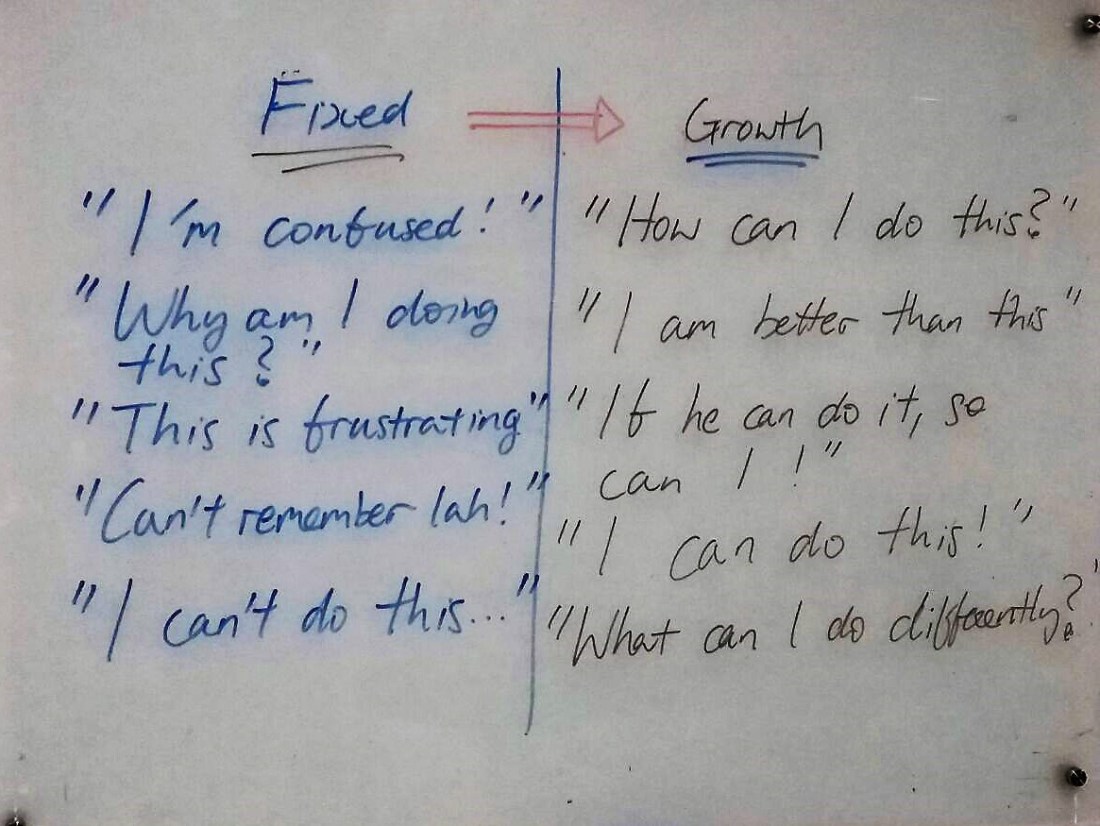
I had a psychology coaching session with a group of young soccer players from 2Touch Soccer last night. When asked what they had learnt in school regarding the Growth and Fixed Mindset, the familiar rhetoric that one mindset is “bad” while the other is “good” surfaced. When probed further, the boys weren’t really sure why the Fixed Mindset was bad, or how to apply the Growth Mindset in order to learn more effectively.

From what I gathered, most Mindset lessons consist of “Information download” where the learner learns about the two different mindsets, i.e., an athlete with the Fixed Mindset is more concerned about looking good rather vs a Growth Mindset who is more inclined towards effort and learning. The learner is often tested for his understanding of the topic through some written test or quiz.

Is this the most effective way to teach Mindset? So what if they know how an athlete with the Growth Mindset thinks? So what if they have been tested? Does it really help them become better athletes?

What’s the value in having the knowledge when you don’t know how to apply it (especially in Sport!)?    

Wouldn’t it be more effective if these athletes physically and emotionally experienced how the growth mindset actually helps them learn more effectively?

Learning by Doing

I got the boys to learn and perform a rope-skipping skill known as the 360 . It was quite a challenging task since most of them have not skipped for a long time and none of them have learnt any rope skipping skills beyond the basic bounce.

2TouchMindset

The session was facilitated through a series of practice and reflection. The boys were able to observe how their thoughts changed from those associated with the Fixed Mindset (when they were first asked to perform the task) to those associated with the Growth Mindset as they began to experience more success (see picture above). Every one of them managed to perform the 360 in the end! The boys are leaving next week to practice with a soccer club in Europe, and they also discussed about how they could apply the same thinking skills to overcome challenges and to learn more effectively while they were there.

Now, let me know what you think about this…if i were to give the boys a written test to assess if they were able to remember the definitions or explain the constructs associated with the Growth Mindset, and they failed the test (which they most likely would!), does that mean that the lesson was any less effective and that little learning has taken place?

While we are at it, let’s also think about Coach Education and how coaches learn. Do we learn best by doing and coaching, or by sitting through lectures and being tested through written examinations?

A coach with a long list of certifications vs. one who spends most of his time actually coaching and learning from his peers…which do you reckon is the better coach?

Coach Hansen