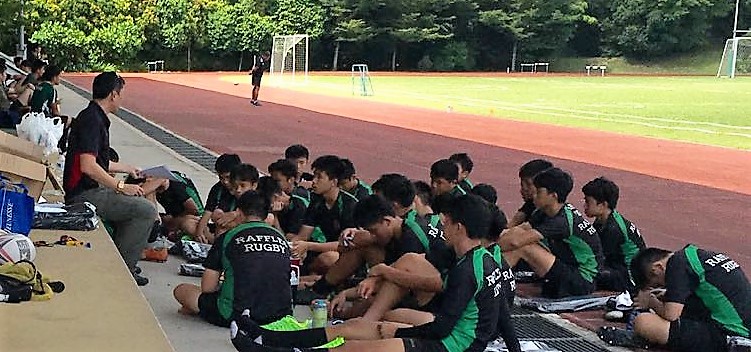
Putting It into Context…

The boys are much more serious about learning and applying mental skills after a couple of competitive games – they are paying attention and asking questions to clarify instead of just “pretending” to be learning.

Mental Prep for Monday's Game vs ACSB
Mental Prep for Monday’s Game vs ACSb

As a psychology coach, I have gotten quite used to this especially with the younger C-Division athletes. These fellas struggle to understand the relevance of mental skills since they can’t really associated the material with a concrete and authentic context, i.e., they often have little or no prior experience of having to perform under pressure.

Contextual Teaching and Learning (CTL) is a concept that reflects a common sense notion that learners learn better when they are taught knowledge within the context of actual experience, rather than abstractly. As much as I try to incorporate CLT strategies into my coaching such as getting the players to focus on process goals under simulated conditions, it seems that nothing beats “real life” experience!

I reckon this is true even outside the context of sport. My former student was sharing investment advice with me last week, and I probably wouldn’t be able to make sense of the advice if I did not have the relevant experience in biz and investments.

“Learning only occurs when the learner wants to learn, is ready to learn, and has a reason to learn…”

Furthermore, I am sure all of us have experienced some sort of screw ups at work or even in relationships, and it was only on hindsight that we realize that all the trouble could have been avoided if we had heeded or remembered a particular someone’s well-meaning advice, which at that point in time seemed irrelevant and/or unnecessary!

I guess it’s human to err, and to err is probably the best way for humans to learn!

Coach Hansen

“The impediment to action advances the action, what stands in the way becomes the way…” Marcus Aurelius

20031553_1896648443925224_8347186897174570739_n

Yup! We did not qualify for the 2017 Asean Para Games (APG).

Our commitment was questionable (attendance wasn’t up to mark) and although the women’s team had good results from friendly games, these were not IBSA sanctioned competitions. Results from IBSA sanctioned events are used as the main benchmarks for qualification.

Unfortunately, the latter is a real challenge mainly because the APG is the ONLY IBSA sanctioned competition for South East Asian countries. The level of competition for other IBSA events are at a much higher level and only Thailand competes at these competitions.

The cost is also high – USD 600 per player for a recent Asia Pacific competition organized by Thailand. Also, our players may not be able to take leave for overseas competition due to work or school commitments.

In addition, unlike our regional counterparts where selection can be made from domestic competitions, we do not have a big pool of players for any meaningful domestic competitions.

Given these circumstances, we will work with the SDSC to come up with a revised plan to measure the team’s progress leading up to APG 2019 (which also marks the end of the team’s five year plan). Should qualification for APG 2019 be improbable, then we will be better off directing our efforts towards a different pathway so long as the team’s core purpose – ‘To provide opportunities for persons with visual impairments to participate in a competitive team sport’ is still met.

Coach Hansen


“The whole is OTHER than the sum of the parts…”


Why are we so proud of coming up with systems, plans and structures blah blah blah?

Am I undermining persons (including myself) who are great at planning and systematizing? Well, Yes and No…

It is a necessary process BUT, almost anyone can design some sort of systems (you can even pay an e-lancer from India or China to sick-sigma almost any process for you). And if you allow yourself to be boxed in and be directed by these systems, chances are that you are very likely to end up being a very good product (aligned with the desired outcomes blah blah blah) of this system.

Very good is relative, and when you have lots of ‘very goods’, what was once ‘very good’ becomes the norm. It is neither interesting, of value nor remarkable!

whole is other than the sum of the parts

What has this got to do with Sport?

There are thousands of technically sound sportsmen who are the products of a highly structured system of training, yet few of them turn out to be Maradonas (soccer), Muhammad Alis (Boxing), Zantarias (Judo), Shaq O’Neals (BBall), Sakurabas (MMA) and Saenchais (MT)  – athletes who have flair, are interesting and remarkable!

So how do we develop flair and how do we coach “flair”? You go figure out on your own lah…

Clue: Systems that are obsessed with micro-managing in order to test and measure every damn thing are not gonna work.

Coach Hansen