
Optimal performance isn’t just about physical preparation; it’s about preparing to show up consistently as the performer you intend to be.
As athletes prepare for the ongoing SEA Games and January’s ASEAN Para Games, one of the key mental tools I help most of them develop is their own compass — a clear set of values and/or attributes that guides how they show up both in and outside of competition.

This compass, however, requires performers to foster a superpower in order fully utilize it: awareness. It is not enough to know what you stand for; you also need to notice the thoughts and behaviors that pull you off course. When athletes align their mindset, actions, and preparation with their compass, they maximize consistency and perform at their best under pressure.
From Drift to Direction…
An example comes from my work with an athlete whose confidence was constantly eroded by comparison. She was continually checking her teammates’ and competitors’ split times; her focus during a race was split between her own stroke and the swimmer in the next lane. She felt anxious, scattered, and never quite “enough.”
We began not by forcing change but by fostering awareness. Through reflective questions like ‘When you’re in that anxious, comparison spiral, what are you actually paying attention to?’ and ‘And what would you be paying attention to if you were perfectly dialed into your own race?’, she mapped out two contrasting versions of herself (see below):
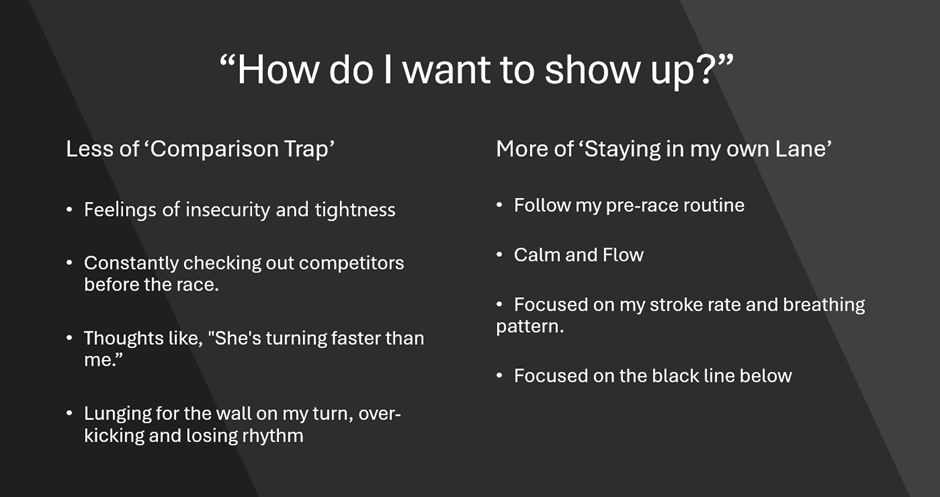
The statement “Stay in my own lane” became her compass point. It wasn’t just a rule of the pool; it was a commitment to her own process. She learned to recognise the familiar tightness in her shoulders as a signal that she was distracted. That physical sensation became her cue to exhale slowly, feel her catch, and reconnect with the rhythm of her own race.
Staying True to Your Compass…
Here’s the important part: Her progress wasn’t a straight line, and it takes time for integration to take place. Even with time, the old habit of comparison would creep back in. The real work wasn’t in never drifting, it was in applying the compass with kindness. Beating herself up for a moment of distraction would only pull her further off course. Instead, she practised noticing the drift without judgment—”Ah, there it is”—and then gently using her cue to return. This self-compassion turned her compass from a stick to measure failure into a tool for genuine navigation.
Besides using the compass as a reflection tool, it can also be used to build your focus routines and as a decision filter.
If you have questions, thoughts, or want to explore how these ideas could apply to your sport or context, feel free to get in touch—I’d love to hear from you.
Coach Hansen
References:
Henriksen, K. (2019). The values compass: Helping athletes act in accordance with their values through functional analysis. Journal of Sport Psychology in Action, 10(4), 199–207.

 Coach Hansen